
The thesis being put forward here is that from the early fifteenth century many Western artists used optics – by which is meant mirrors and lenses (or a combination of the two) – to create living projections. Some artists used these projected images directly to produce drawings and paintings, and before long this new way of depicting the world – this new way of seeing – and become widespread. Canaletto and Vermeer, in particular, are often cited as two artists who used camera obscura in their work. But until now, no one has suggested that optics were used as widely or as early as some researchers are suggesting.
The camera obscura is an integral part to understanding how modern day photography developed and how some artists worked. However, it’s a pretty confusing concept if you’ve never really looked into the mechanics of how one works or experienced one yourself. This lesson is meant to explain the ins and outs of how the camera obscura functions as well as its place in history. We will look at how it developed out of scientific circles into the art world and how artists, both past and present, have used it.
What Is Camera Obscura?
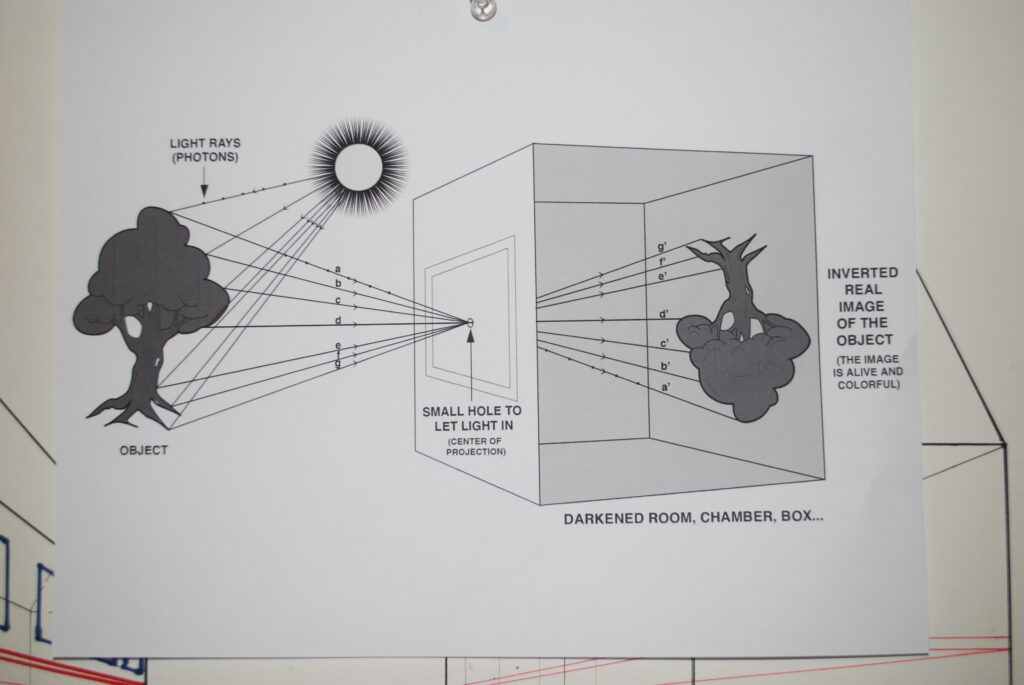
Camera obscura (meaning “dark room” in Latin) is a box-shaped device used as an aid for drawing or entertainment. Also referred to as a pinhole image, it lets light in through a small opening on one side and projects a reversed and inverted image on the other.
As the name suggests, many historical camera obscura experiments were performed in dark rooms. The surroundings of the projected image have to be relatively dark for the image to be clear. The human eye works a lot like the camera obscura; both have an opening (pupil), a biconvex lens for refracting light, and a surface where the image is formed (retina).
Early camera obscura devices were large and often installed inside entire rooms or tents. Later, portable versions made from wooden boxes often had a lens instead of a pinhole, allowing users to adjust the focus. Some camera obscura boxes also featured an angled mirror, allowing the image to be projected the right way up.